Gramática: Los Verbos Reflexivos
Learning reflexive verbs is not difficult, but it does take some practice as they are not a formal part of English grammar.
A "reflexive" sentence is one in which the subject does something to him/herself. Or put another way, the subject and the object of the sentence refer to the same person. The action of the verb in a reflexive sentence is "reflected" back onto the subject. Compare:
I read the book.
I wash myself.
In the first sentence the action of the verb, reading, is passed onto an object, the book. The sentence is not reflexive. But in the second sentence, the person doing the washing and the person being washed is one and the same. The second sentence is reflexive.
In English we deal with reflexives by adding words like "himself" or "yourself" to the sentence. In Spanish we use a special class of verbs known as "reflexive verbs" which have their own unique rules.
Spanish Reflexive Verbs
In their infinitive form, reflexive verbs end with a "-se" after the usual "-ar," "-er," or "-ir." For example if you look up "to shave" in a Spanish/English dictionary, you'll find "afeitarse" and you can see from its "-se" ending that it is a reflexive verb. Here are some other reflexive verbs. Notice the "-se" endings:
despertarse: to wake up
levantarse: to get up
sentarse: to sit down
acostarse: to go to bed
The "-se" at the end of each verb is something known as a "reflexive pronoun" and we'll need to pay special attention to it when we conjugate.
Conjugating Reflexive Verbs
To conjugate a reflexive verb we first take the "-se" ending and place it in front of the verb. Then we conjugate as we normally would. Here's the process for saying "I shave":
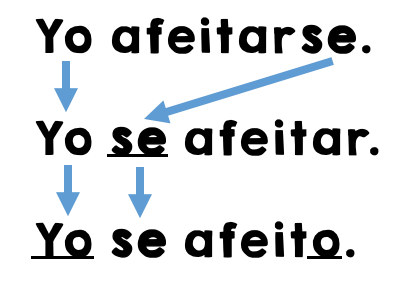
Note: In English when someone says "I shave" it's understood that they're talking about shaving themselves. Rarely does anyone say, "I shave myself." But in Spanish we're a bit more explicit.
This is a good start, but we're not quite done. Just as the verb ending, "-o," needs to agree with the subject, our reflexive pronoun, se, needs to agree as well. In this case, the se needs to become me :
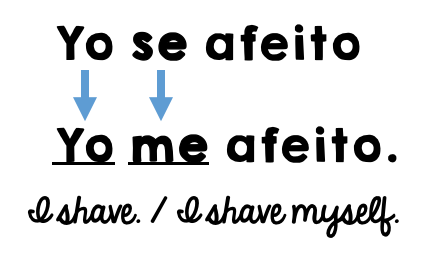
So the reflexive pronoun se becomes me when the subject is yo. What about other subjects?
Spanish Reflexive Pronouns
Here's the list of reflexive pronouns in Spanish, with subject pronouns for comparison:

Therefore a complete set of sentences using afeitarse as the verb would look like this:
Yo me afeito.
Tú te afeitas.
Róger se afeita.
Nosotros nos afeitamos.
Vosotros os afeitáis.
Mis amigos se afeitan.
Common Reflexive Verbs
Notice that with reflexive verbs the subject, the reflexive object, and the verb ending are all in agreement (because the subjects are doing the action to themselves). Some more examples:
|
Tú te despiertas. |
Ella se levanta. |
Nosotros nos sentamos. |
Uds. se acuestan. |
Two things to be aware of before we get any further:
- Reflexive pronouns are not optional. This "extra" reflexive pronoun can be frustrating for students who are already busy enough trying to remember the verb endings and as a result it often gets ignored, but we can't just ignore the things we find difficult.
- Reflexive pronouns do not replace the subject. Nos is not the same as nosotros. It's not an abbreviation either.
So how do you know if a verb is reflexive or not? Well, the idea that reflexive verbs are used when the subject does the action to him/herself is a good starting place, but the truth is you really need to memorize which verbs are reflexive and which ones aren't. You won't be able to tell from context whether you need to add a reflexive pronoun or not. For some reflexive verbs it's quite obvious why they are reflexive but other reflexive verbs may make no sense to you whatsoever.
Here's a list of commonly used reflexive verbs:
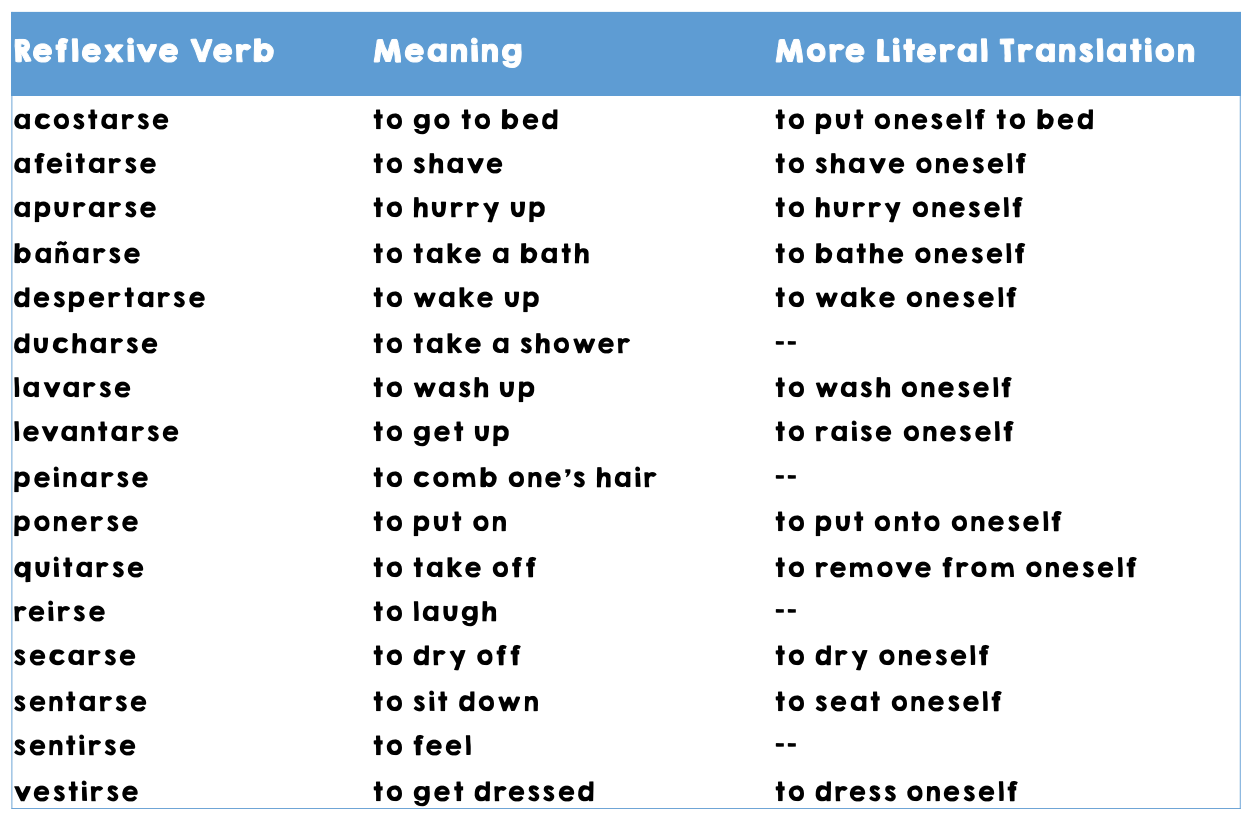
A few things to note from the list above:
- Many reflexive verbs have to do with daily routine: washing, combing, drying, etc. and many have to do with emotions.
- As mentioned before it's not obvious why some of these verbs are reflexive; they just are. The sooner you accept that, the better off you'll be.
- Some of the verbs listed are inherently reflexive and can't be conjugated any other way. Some also have non-reflexive forms that convey different meanings. Speaking of which...
Note: Ponerse means "to put on" but it can also mean "to become."
Reflexive Verbs as Intensifiers
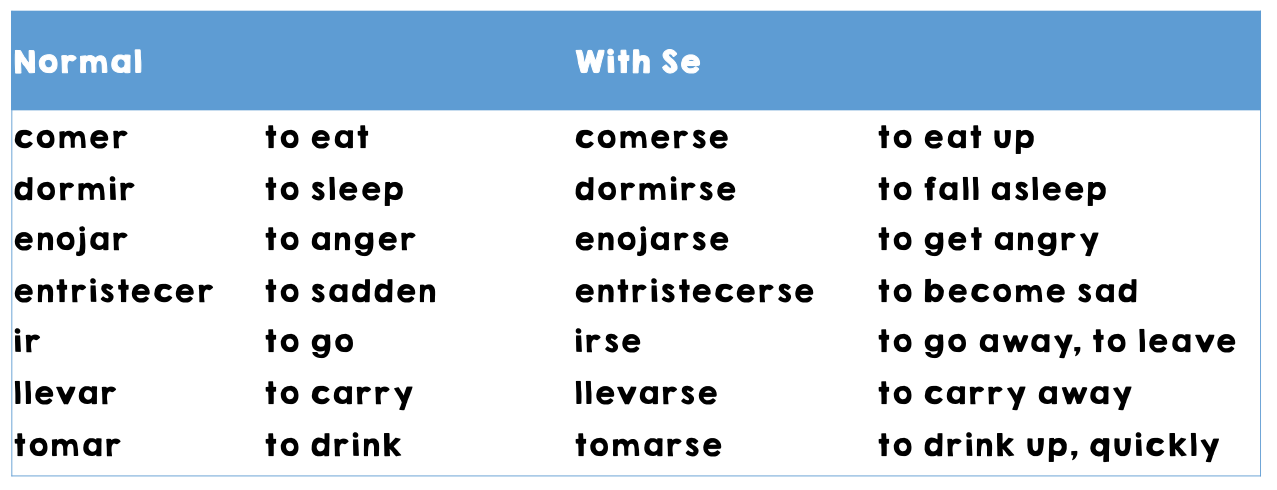
Sometimes we can add a reflexive pronoun to a verb that isn't normally reflexive to "intensify" it or give it a stronger meaning. We can also use reflexive pronouns to convey a sense of "getting" or "becoming":
Possessive Adjective Replacement
When using reflexive verbs we frequently omit possessive adjectives and use definite articles instead (this tends to happen with body parts and articles of clothing). The reflexive pronoun does the job of the possessive adjective:
|
|
Yo me seco el pelo. |
I dry my hair. |
|
|
Juana se lavó las manos. |
Juana washed her hands. |
|
|
Tú te pones el abrigo. |
You put on your jacket. |
Reflexive Pronoun Placement
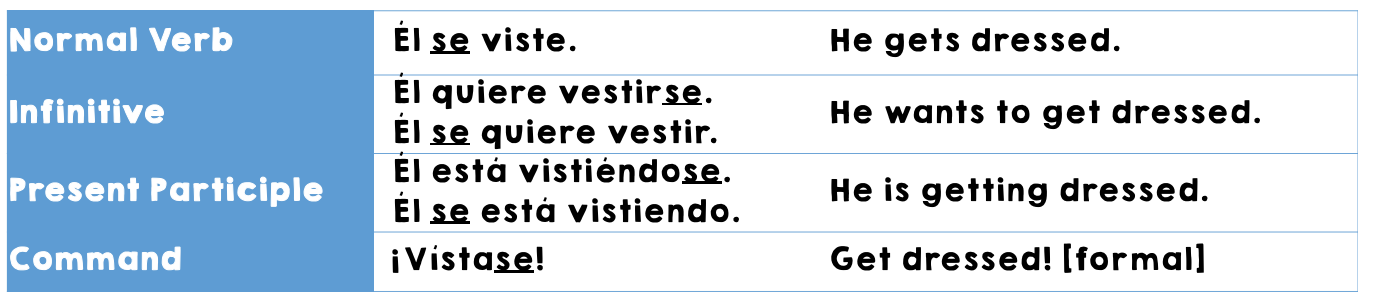
Like other pronouns, reflexive pronouns are placed before a "normal" conjugated verb. But they can attached to present participles and infinitives if they're available. Reflexive pronouns must be attached to affirmative commands. Some examples:
¡Ojo! [Careful]
The reflexive object must agree with the subject even if the verb it's attached to isn't conjugated:
|
Tú puedes lavarte las manos. |
Nosotros queremos acostarnos temprano. |
Using Mismo For Emphasis
In addition to using a reflexive pronoun, we can also use a form of mismo to really emphasize the reflexive nature of an action:
|
¿Porqué no puedes perdonarte a ti mismo? |
Ella se cuida a ella misma. |
There are several presentations below which describes how sentences are structured using these kinds of verbs. Take notes as you view the material as you will be responsible for the content. Be sure your speakers are turned up.
Reflexive Verbs
Using Reflexive Verbs in Spanish
Using Stem-changing Reflexive Verbs in Spanish!
Reflexive Verbs Made Easy with a Song!
Below you will find another approach/explanation to reflexives by a Spanish teacher, Sr. Lafontant.
Los Verbos Reflexivos: La Conjugación y El Vocab
Los Verbos Reflexivos
Before beginning the self-assessments for this grammar topic, on the sidebar you may want to review the various extra tutorials available. When you are finished, try doing the self-assessments listed below.
Reflexive Verbs Review Activities
Below are several review activities to help you practice reflexive verbs.
