La Rutina Diaria y Las Enfermedades
Spanish II
Introduction
 In this module students will learn about reflexive verbs and vocabulary associated with them. They will also be able to communicate how they feel in terms of one's physical state. Possessive adjectives are an additional grammar concept within the module. Culture will focus on the smoking population in Spain.
Essential Questions:
- Do you know how to say that you are ill in Spanish?
- What is a reflexive verb and how is it conjugated?
- What is a possessive adjective and how is it used in Spanish?
- What is your daily routine?
- How do I use the definite article correctly?
Key Terms
Verbos Reflexivos: Reflexive Verbs
La Rutina Diaria: Daily Routine
Las Enfermedades: Illnesses
Adjetivo Posesivo: Possessive Adjective
Lectura: Reading
Escuchar: Listening to daily routines
Conversar: Speaking about daily routine
Learning Tasks: Vocabulario
This chapter's vocabulary uses words associated with one's daily routine and illnesses. It is highly recommended that you make a vocabulary list of the terms from both sections as well since you will be using them for projects and as a study guide for your module test.
La Rutina Diaria Vocabulario
This chapter's vocabulary uses words associated with one's daily routine. Note that most of vocabulary words end in "-se." These words are known as reflexive verbs and you will learn about them later in this module.
|
acostarse (o>ue): to go to bed
dormirse (o>ue): to fall asleep
despertarse (e>ie): to wake up
levantarse: to get up
lavarse: to wash
bañarse: to bathe
afeitarse: to shave
cepillarse los dientes: to brush one's teeth
vestirse: to get dressed
descansar: to rest, to relax
arreglarse: to get ready
enojarse: to become angry
apurarse: to hurry
divertirse (e>ie): to have fun
acordarse (o>ue): to remember
|
ducharse: to take a shower
maquillarse: to put on makeup
peinarse: to comb one's hair
quitarse: to take off
secarse: to dry off
el peine: comb
el pinta labios: lip stick
la máquina de afeitar: shaver
la pasta de dientes: toothpaste
el cepillo de dientes: toothbrush
el cepillo de pelo: hair brush
el champú: shampoo
la toalla: towel
el jabón: soap
el maquillaje: makeup
|
Pronunciation
Watch the video with the vocabulary and listen to the pronunciation of your vocabulary as many times as needed. Practice repeating the terms.
Vocabulario Review
Las Enfermedades Vocabulario
 Below you will find vocabulary expressions associated with physical states and illnesses. Be able to use them correctly.
|
Estar en buena forma: To be in good shape
Me duele el estómago: My stomach aches
Tengo la gripe: I have the flu
Me duele la cabeza: I have a headache/My head hurts
Estar resfriado(a): To have a cold
Me duele la espalda: My back hurts/I have a backache
Me duelen las piernas: My legs hurt
Me duele el pie: My foot hurts
Estar enfermo(a): To be sick, to be ill
Estar cansado(a): To be tired
|
Pronunciation
Watch the video with the vocabulary sand listen to the pronunciation of your vocabulary as many times as needed. Practice repeating the terms.
Vocabulario Review
Gramática: Los Verbos Reflexivos
Learning reflexive verbs is not difficult, but it does take some practice as they are not a formal part of English grammar.
A "reflexive" sentence is one in which the subject does something to him/herself. Or put another way, the subject and the object of the sentence refer to the same person. The action of the verb in a reflexive sentence is "reflected" back onto the subject. Compare:
I read the book.
I wash myself.
In the first sentence the action of the verb, reading, is passed onto an object, the book. The sentence is not reflexive. But in the second sentence, the person doing the washing and the person being washed is one and the same. The second sentence is reflexive.
In English we deal with reflexives by adding words like "himself" or "yourself" to the sentence. In Spanish we use a special class of verbs known as "reflexive verbs" which have their own unique rules.
Spanish Reflexive Verbs
In their infinitive form, reflexive verbs end with a "-se" after the usual "-ar," "-er," or "-ir." For example if you look up "to shave" in a Spanish/English dictionary, you'll find "afeitarse" and you can see from its "-se" ending that it is a reflexive verb. Here are some other reflexive verbs. Notice the "-se" endings:
despertarse: to wake up
levantarse: to get up
sentarse: to sit down
acostarse: to go to bed
The "-se" at the end of each verb is something known as a "reflexive pronoun" and we'll need to pay special attention to it when we conjugate.
Conjugating Reflexive Verbs
To conjugate a reflexive verb we first take the "-se" ending and place it in front of the verb. Then we conjugate as we normally would. Here's the process for saying "I shave":
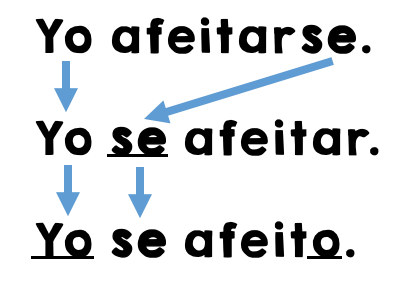
Note: In English when someone says "I shave" it's understood that they're talking about shaving themselves. Rarely does anyone say, "I shave myself." But in Spanish we're a bit more explicit.
This is a good start, but we're not quite done. Just as the verb ending, "-o," needs to agree with the subject, our reflexive pronoun, se, needs to agree as well. In this case, the se needs to become me :
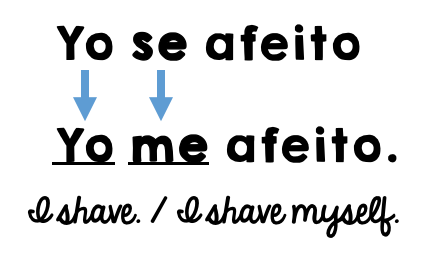
So the reflexive pronoun se becomes me when the subject is yo. What about other subjects?
Spanish Reflexive Pronouns
Here's the list of reflexive pronouns in Spanish, with subject pronouns for comparison:

Therefore a complete set of sentences using afeitarse as the verb would look like this:
Yo me afeito.
Tú te afeitas.
Róger se afeita.
Nosotros nos afeitamos.
Vosotros os afeitáis.
Mis amigos se afeitan.
Common Reflexive Verbs
Notice that with reflexive verbs the subject, the reflexive object, and the verb ending are all in agreement (because the subjects are doing the action to themselves). Some more examples:
|
Tú te despiertas.
You wake up.
|
Ella se levanta.
She gets up.
|
Nosotros nos sentamos.
We sit down.
|
Uds. se acuestan.
You go to bed.
|
Two things to be aware of before we get any further:
- Reflexive pronouns are not optional. This "extra" reflexive pronoun can be frustrating for students who are already busy enough trying to remember the verb endings and as a result it often gets ignored, but we can't just ignore the things we find difficult.
- Reflexive pronouns do not replace the subject. Nos is not the same as nosotros. It's not an abbreviation either.
So how do you know if a verb is reflexive or not? Well, the idea that reflexive verbs are used when the subject does the action to him/herself is a good starting place, but the truth is you really need to memorize which verbs are reflexive and which ones aren't. You won't be able to tell from context whether you need to add a reflexive pronoun or not. For some reflexive verbs it's quite obvious why they are reflexive but other reflexive verbs may make no sense to you whatsoever.
Here's a list of commonly used reflexive verbs:
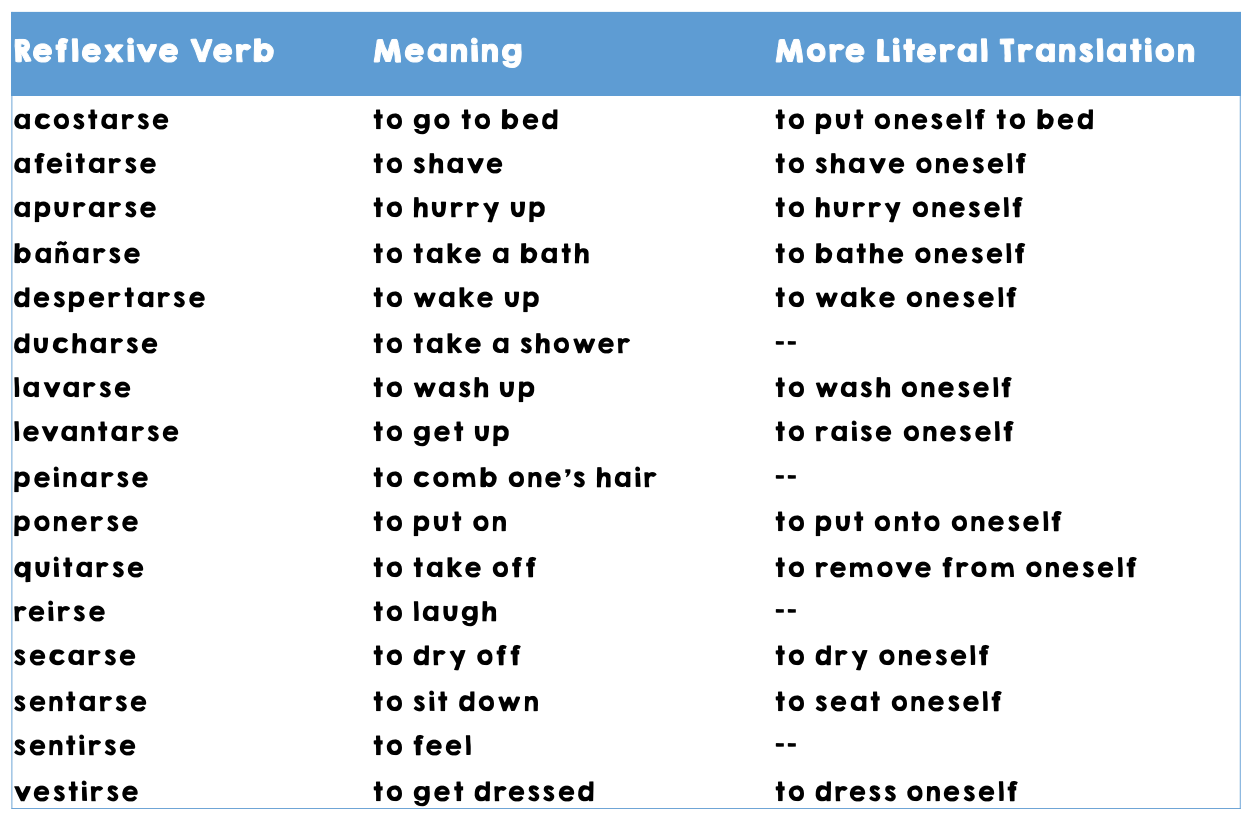
A few things to note from the list above:
- Many reflexive verbs have to do with daily routine: washing, combing, drying, etc. and many have to do with emotions.
- As mentioned before it's not obvious why some of these verbs are reflexive; they just are. The sooner you accept that, the better off you'll be.
- Some of the verbs listed are inherently reflexive and can't be conjugated any other way. Some also have non-reflexive forms that convey different meanings. Speaking of which...
Note: Ponerse means "to put on" but it can also mean "to become."
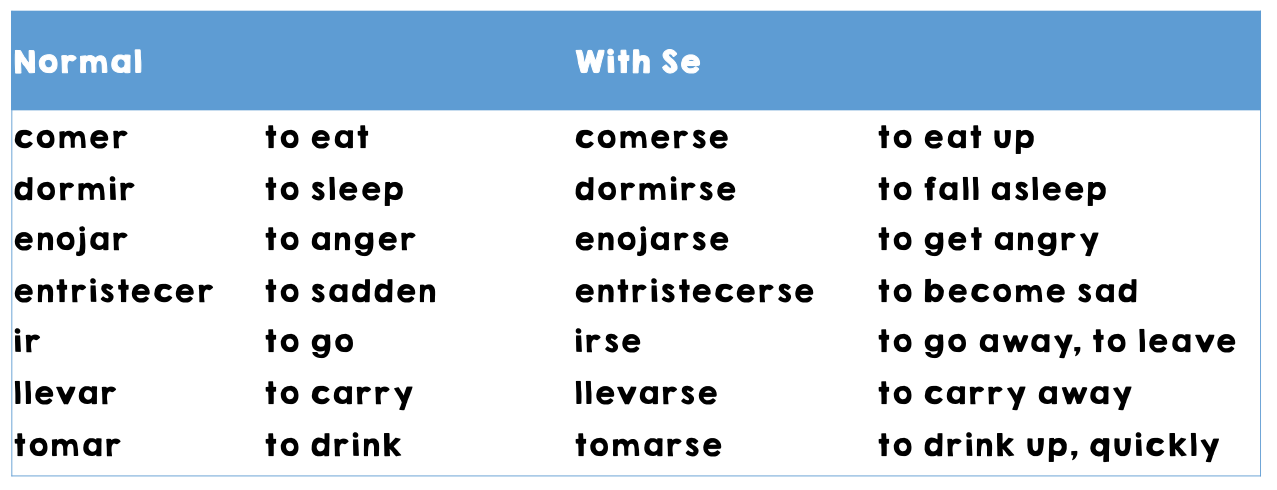
Reflexive Verbs as Intensifiers
Sometimes we can add a reflexive pronoun to a verb that isn't normally reflexive to "intensify" it or give it a stronger meaning. We can also use reflexive pronouns to convey a sense of "getting" or "becoming":
Possessive Adjective Replacement
When using reflexive verbs we frequently omit possessive adjectives and use definite articles instead (this tends to happen with body parts and articles of clothing). The reflexive pronoun does the job of the possessive adjective:
|
Yo me seco mi pelo.
|
Yo me seco el pelo.
|
I dry my hair.
|
|
Juana se lavó sus manos.
|
Juana se lavó las manos.
|
Juana washed her hands.
|
|
Tú te pones tu abrigo.
|
Tú te pones el abrigo.
|
You put on your jacket.
|
Reflexive Pronoun Placement
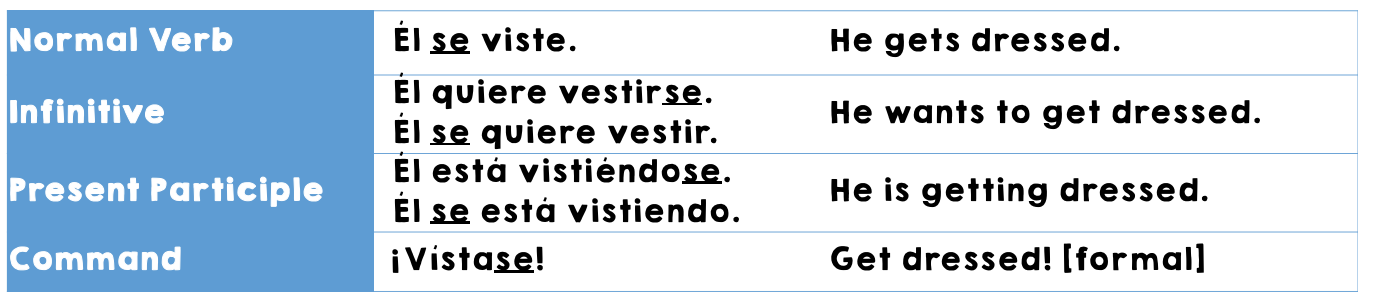
Like other pronouns, reflexive pronouns are placed before a "normal" conjugated verb. But they can attached to present participles and infinitives if they're available. Reflexive pronouns must be attached to affirmative commands. Some examples:
¡Ojo! [Careful]
The reflexive object must agree with the subject even if the verb it's attached to isn't conjugated:
|
Tú puedes lavarte las manos.
You can wash your hands.
|
Nosotros queremos acostarnos temprano.
We want to go to bed early.
|
Using Mismo For Emphasis
In addition to using a reflexive pronoun, we can also use a form of mismo to really emphasize the reflexive nature of an action:
|
¿Porqué no puedes perdonarte a ti mismo?
Why can't you forgive yourself?
|
Ella se cuida a ella misma.
She takes care of herself.
|
There are several presentations below which describes how sentences are structured using these kinds of verbs. Take notes as you view the material as you will be responsible for the content. Be sure your speakers are turned up.
Reflexive Verbs
Using Reflexive Verbs in Spanish
Using Stem-changing Reflexive Verbs in Spanish!
Reflexive Verbs Made Easy with a Song!
Below you will find another approach/explanation to reflexives by a Spanish teacher, Sr. Lafontant.
Los Verbos Reflexivos: La Conjugación y El Vocab
Los Verbos Reflexivos
Before beginning the self-assessments for this grammar topic, on the sidebar you may want to review the various extra tutorials available. When you are finished, try doing the self-assessments listed below.
Reflexive Verbs Review Activities
Below are several review activities to help you practice reflexive verbs.
Gramática: Adjetivos Posesivos
Possessive adjectives, as in English, are used to express ownership of something, such as "my book" or "his friends." There is a presentation below which describes how sentences are structured using these kinds of verbs. Take notes as you view the material as you will be responsible for the content. Be sure your speakers are turned up!
Possession Using De
In English when we want to indicate that something belongs to someone we add an apostrophe and an "s" to their name. For example:
Susana's book
Francisco's bicycle
Esteban and David's dogs
We cannot do the same in Spanish. There is no apostrophe in Spanish and adding an "s" just makes things look plural. Instead we need to use the following formula including the word de (meaning "of"):

NOTE: You can also use general nouns instead of names: el equipo de la escuela.
Here are the examples from above in their Spanish translation:
el libro de Susana
la bicicleta de Francisco
los perros de Esteban y David
Simple enough, right? But we don't always use people's names to indicate possession.
Possession with Possessive Adjectives
You don't normally think of them this way, but words like "my," "your," "our," and "their" are actually adjectives. They do, after all, modify nouns like any other adjective.
In fact they are known as "possessive adjectives." Here are all of the English possessive adjectives: my, your, his, her, its, our, your, and their.
In Spanish, as in English, there are two types of possessive adjectives: short form and long form. We'll look at the short form for this particular module:
Short Form Possessive Adjectives in Spanish
The basic short form possessive adjectives look like this: mi, tu, su, nuestro, vuestro, and su.
You may be wondering why tu doesn't have the accent you're accustomed to seeing. Remember the word tú is a subject pronoun and means "you." The word tu (without the accent) is an adjective and means "yours." Understanding this distinction is very important.
We use short form possessive adjectives in Spanish the same way we do in English. We place the adjective in front of the noun. The formula looks like this:

Here are some examples:
English: my car, your car, our car
Spanish: mi coche, tu coche, nuestro coche
If the examples above look pretty easy, they're only the basic forms. Like any good Spanish adjective, possessive adjectives need to agree in number so we have some variations for plural forms:
mi, mis: nuestro, nuestros
tu, tus: vuestro, vuestros
su, sus: su, sus
Now would be a good time to talk about what we mean by "plural" in this situation. The plural form is used when we have more than one thing being possessed, not when we have more than one possessor:
English: my cars, your cars, our car
Spanish: mis coches, tus coches, nuestro coche
In the first example, since there is more than one car, "my" is translated in the plural mis even though there is only one of me. Similarly in the second example, "your" is translated in the plural tus even though there is only one of you. In the last example there is more than one of us, but we use the singular nuestro because this time there is only one car. If you can remember that adjectives (even possessive adjectives) only agree with the nouns they modify, this concept shouldn't be too difficult.
But now it's going to start to get complicated, because Spanish adjectives also need to agree in gender. Look at our (simplified) possessive adjectives again:
mi(s): nuestro(s)
tu(s): vuestro(s)
su(s): su(s)
We can't really change the "i" in mi from one gender to another since "i" is gender-neutral. The same thing can be said for the "u" in both tu and su. We can, however, change nuestro and vuestro from their current masculine states to feminine ones which means we have even more variations:
mi(s): nuestro(s), nuestra(s)
tu(s): vuestro(s), vuestra(s)
su(s): su(s)
Just like how we decide whether to use a singular or a plural adjective, we pick a masculine or a feminine adjective based on the gender of the thing(s) being possessed, not the gender of the possessor:

In the first example nuestra agrees (in gender and in number) with the noun it modifies, bicicleta, and has nothing to do with the fact that it belongs to a group of girls. You'll notice that changing the ownership to a group of boys does nothing to the phrase because the noun being modified is still bicicleta (singular and feminine). Likewise in the last example nuestros agrees in gender and in number with libros and has nothing to do with the girls (gender or number) who own the books.
Ambiguity With Su and Sus
How would you translate these phrases?
su camisa
su coche
sus llaves
Looking at our charts we see that su and sus could mean "his," "her," "its," "your" (in the Ud. or Uds. form), or even "their." While there wouldn't be much confusion with any of the other possessive adjectives, su and sus cause some trouble since they can mean so many different things. What do Spanish-speaking people do in order to be understood?
First of all, context will take care of most of these kinds of problems. If these phrases popped-up in a conversation about Gloria, for example, it would be fairly clear that they mean "her shirt," "her car," and "her keys." But if you heard them it in a conversation about different things belonging to different people, it wouldn't be so clear. If context doesn't help, we can use a more accurate construction including the preposition de.
Some Examples:
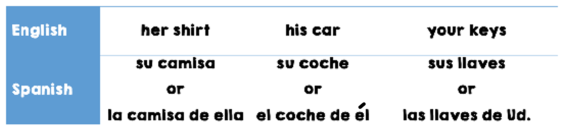
(You may be wondering why "de él" doesn't get shortened to "del." It's important that we don't shorten it in this situation because "de él" doesn't mean "of the" but rather "of he" meaning "his.")
It looks strange to English speakers but possessive adjectives are frequently omitted when talking about body parts and clothing (and other items closely associated with a person). This is especially true of sentences including an object pronoun:

Possessive Adjectives Review Activities
Below are several review activities to help you practice possessive adjectives.
Gramática: More on Definite Articles
Figuring out when to use articles in Spanish can be a bewildering task for an English speaker. Sometimes the two languages correspond beautifully; sometimes they are complete opposites. One general rule of thumb: Definite articles are used much more often in Spanish.
Facts & General Opinions
Unlike English, Spanish uses the definite article to express general truths or concepts. Compare the following sentences with their English translation:
|
I know that with that career I can help people much more.
Sé que con esa carrera yo puedo, o sea, ayudar a la gente mucho más.
My mom didn't like the United States; life here was very difficult.
A mi mamá no le gustaban los Estados Unidos; la vida aquí era muy difícil.
Food from Andalusia is delicious.
La comida de Andalucía es deliciosa.
Chinese food is fantastic!
¡La comida china es fantástica!
|
Days of the Week
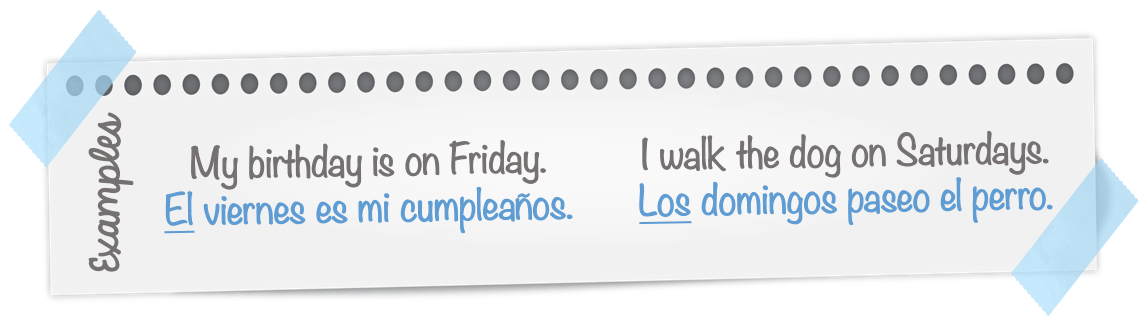
Days of the week typically are preceded by either el or los, depending on whether the day is singular or plural (the names of the weekdays don't change in the plural form).
Voy a la tienda el jueves. (I'm going to the store on Thursday.) Voy a la tienda los jueves. (I go to the store on Thursdays.) The article isn't used following a form of the verb ser to indicate which day of the week it is. Hoy es lunes. (Today is Monday.)
Languages
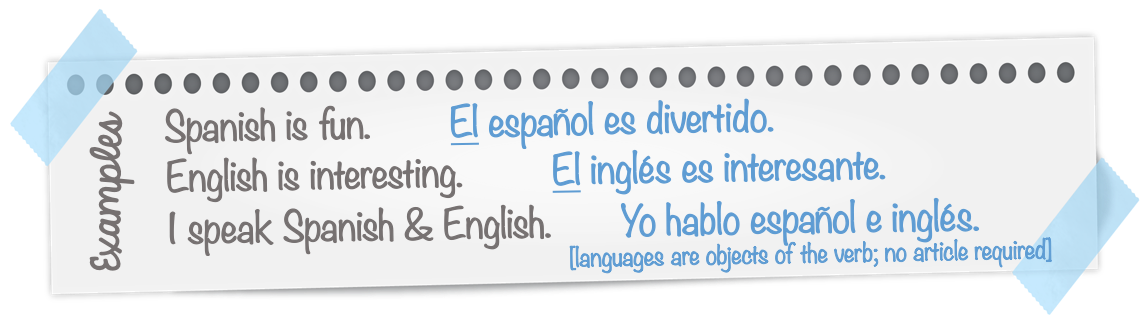
Spanish is fun. El español es divertido. / English is interesting. El inglés es interesante; I speak Spanish. Yo hablo españo [none needed when the language is the object of the sentence].
Body Parts, Clothing, and Personal Items
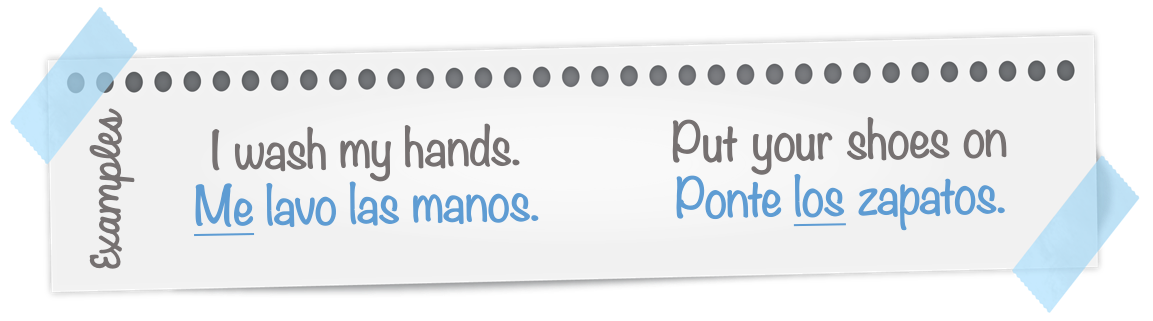
It is very common to use the definite article in Spanish in cases where a possessive adjective (such as "your") would be used in English. Examples: ¡Abre los ojos! (Open your eyes!) Perdió los zapatos. (He lost his shoes.)
Telling Time
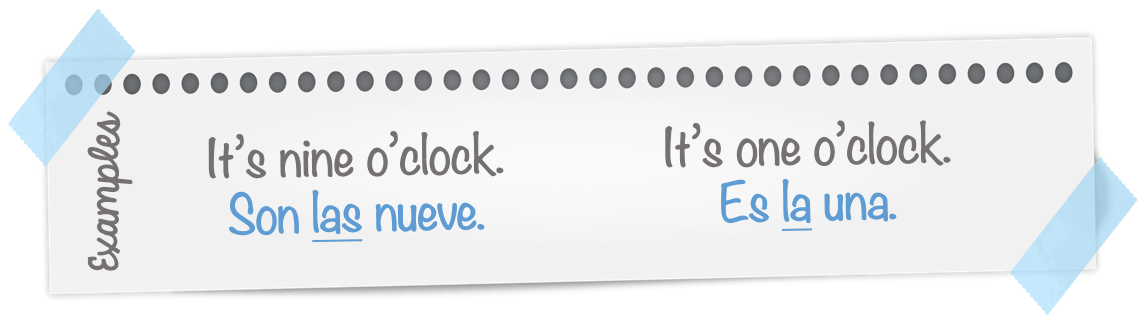
Definite articles are used before numbers when telling time. The definite article used for telling time is always feminine since it references la hora.
Possession
How to Express Possession with "de" in Spanish
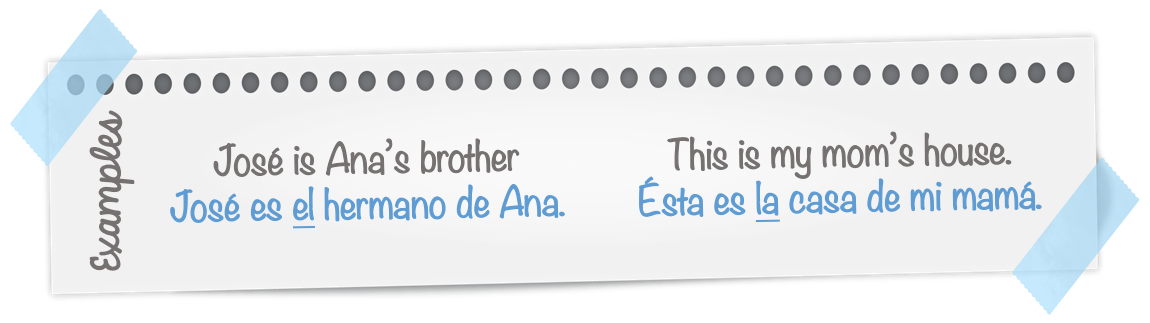
Expressing possession in Spanish can be done by using the word "de". Expressing possession with an apostrophe and an "s" ('s) is never ever possible in Spanish! So, forget about "Ana's amigo". If you want to say, "Ana's friend", you have to say "El amigo de Ana", otherwise, you are not speaking Spanish, but Spanglish. Another difference is that in Spanish, the possessor goes after the object possessed, right after the word "de". Look at the following examples:
- La casa de Mario (Mario's house - Literally: The house of Mario).
- La casa del (de + el = del) señor García (Mr. García's house - Literally: The house of Mr. García).
Notice how in the second example, the word de and el (for el señor) becomes del. Whenever de is followed by el, we say del instead of de el. For de la, de las, and de los we do not do a contraction. Keep in mind that when a proper name follows, we use de, as in la casa de Rita (Rita's house), not la casa de la Rita.
Titles
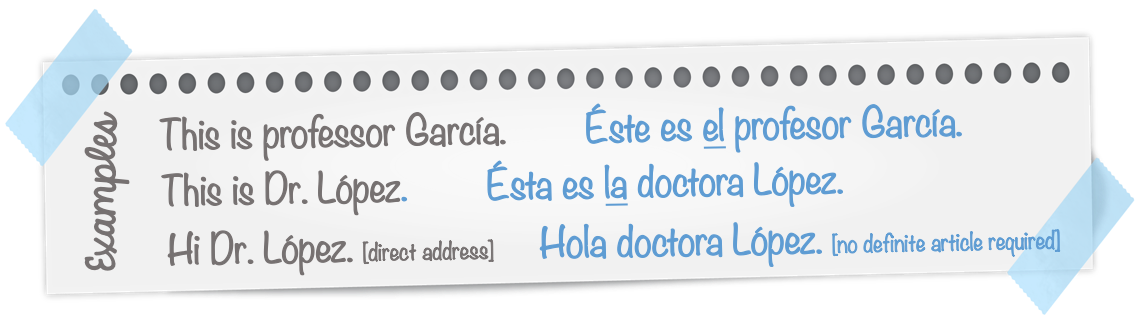
The article is used before most personal titles when talking about people, but not when talking to them. El señor Smith está en casa. (Mr. Smith is at home.) But, hola, señor Smith (hello, Mr. Smith ). La doctora Jones asistió a la escuela. (Dr. Jones attended the school.) But, doctora Jones, ¿como está? (Dr. Jones, how are you?)
Definite Articles Review Activity
Learning Tasks: Escuchar, Lectura, y Cultura
Escuchar
Listen to native speakers describe their typical daily activities.
|
Simplified Example:
Spanish
|
|
|
Leonardo G.
México, D.F.
|
|
|
Claudia V.
Perú, Lima
|
|
|
Alberto R.
España, Pamplona, Navarra
|
|
|
Medardo C.
República Dominicana, Santo Domingo
|
|
|
Mária M.
Bolivia, Oruro
|
|
See if you can answer the questions below based on the audio clips you listened to above. Hover your mouse over the questions to check your answers and see if you got it right!












What is your daily routine? Would you be able to write a few paragraphs about it? On the sidebar there is a handout and questions titled, "La Rutina Diaria." The paragraphs depict a typical day is written using the preterite tense. Because reflexive verbs are an essential part of this module, answering the questions is a great self-assessment to see how well you understood the paragraphs!
Lectura: Las Enfermedades
Have you had an accident while participating in a sporting event? Do you go to the doctor when you are sick? Below are sentences about accidents and illnesses. Read the sentences carefully. Use your vocabulary lists to help you. When finished, you will use a health chart on an upcoming assessment page that will verify how much of the information you understood.
Lee las frases que dicen que les pasa a tus amigos...
- Mónica se levanta a las siete de la mañana. Ella no está bien. Le duele la espalda y está muy cansada. Ayer ella corrió por tres horas. Ella piensa que es el problema. No quiere ir a la escuela hoy.
- Enrique regresa a la casa a las 4:00. Está enfermo y su madre piensa que tiene el gripe. Se acuesta a las 6:00. Cuando su amigo llama por teléfono, está sorprendido porque Enrique no puede hablar con él.
- Marco va a las montañas para esquiar, ¡Qué desastre! Él se cayó y ahora le duelen las piernas y los pies. Pobre Marco.
- Hoy Mario va al dentista. Tiene miedo porque no le gusta ir al dentista. Pero, tiene que ir porque le duelen los dientes.
- Verónica se levanta y no está en buena forma. Le duele el estómago. Ella comió demasiada pizza ayer por la noche.
- La madre de Jorge le dio una aspirina. Le duele la cabeza. Él se cayó durante un partido de fútbol. Su amigo llamó y preguntó, <<¿Qué tal?>> Jorge respondió, <<No estoy bien, no me siento bien.>>
- Antonio se despierta y se levanta. Se afeita. Se corta la cara con la máquina de afeitar. Se enoja. Tiene una cita esta noche con su novia y tiene una herida en la cara.
- Hacía mucho frío ayer. Emilia se lavó el pelo, se vistió, y se fue de la casa. Su pelo estaba mojado (wet). Ahora está resfriada. El doctor dice que no está enferma por el pelo mojado.
Cultura
Smoking is not considered "taboo" in many Spanish-speaking countries like it is in the United States. However, times are changing and smoking has been banned in certain areas. Go to the sidebar and read "Cultura España y el Tabaco". When finished, underneath the article complete the handout titled, "Handout Cultura-España y el Tabaco." You will see some of this material again on your module test.
Assignments: Vocabulary and Grammar
Vocabulario La Rutina Diaria Project

Choose one of the following activities for your vocabulary and grammar assessment. This is your chance to show off your creativity! Ask your teacher if you have questions or concerns. If you feel confident meeting all the prerequisites using another format to present your project, get in touch with your instructor and get approval. Remember, no matter what option you select, you must include: vocabulary and grammar from this module, and sentences written correctly using the content in meaningful exchanges.
Option A
Create a slideshow using either clip art or personal pictures which depicts your daily routine or ailments. You will want to use more than one vocabulary word per slide to cut down on the file size. Feel free to use Power Point. You are required to use a total of 16 vocabulary words (some from each section). In the "Ejemplo" sidebar is an example which has different vocabulary, but demonstrates how your completed project should look. You will need to create 8 sentences minimum. See the sample in the "Ejemplo" sidebar.
Option B
Create a concept map using items from your vocabulary lists. Some options for your categories may be "La Mañana, La Tarde, Cosas para limpiarme" or others. The sidebar has a free option for you or you may create your own using other software. A total of 16 vocabulary words must be used (some from each section). In the "Ejemplo" sidebar is a partial example which demonstrates how your completed project should look. Take a screen shot of your concept map and insert it into a Word document. At the bottom of the concept map document you are to have 8 complete sentences minimum describing your daily routine in Spanish using the vocabulary and grammar from this module.
Option C
Create a slideshow using either clip art or personal pictures which depict daily routines or ailments of any family member or sibling. You will want to use more than one vocabulary word per slide to cut down on the file size. You are required to use a total of 16 vocabulary words (some from each section). In the "Ejemplo" sidebar is an example which demonstrates how your completed project should look. You will need to create 8 sentences minimum. See the sample in the "Ejemplo" sidebar.
Option D
If you prefer to use another presentation format, get in touch with your insrtuctor and explain to him/her what you would like to do.
Submit your completed assignment when you are finished.
Lectura Enfermedades Assignment
Previously in this module you were asked to read and comprehend the information about accidents and illnesses. The readings "Las Enfermedades" for this assessment are located on a previous page. Download the document named "Lectura Health Chart" and follow the instructions. Place a 'x' in the box of the name of the person who has the ailments listed. Submit your completed assignment when you are finished.
Rincón Cultural
It would be advisable to keep a file on the Cultural Capsules throughout the entire course. Taking notes for each cultural capsule in the course will help you prepare for your quizzes and tests. Always keep in mind you will have questions that pertain to the highlighted module country/countries on your module test as well as the final exam.
Venezuela
Ecuador
Repaso
Be sure you can answer the following review questions before moving on to your final module test. Return to previous lessons in this module if you need to review topics or concepts.
- Can you name at least 6 reflexive verbs in their infinitive form?
- Would you be able to tell someone what hurts you?
- How do we conjugate a reflexive verb?
- Can you name all the possessive adjectives? Which ones change their ending according to a masculine or feminine noun?
- Would you be able to use definite articles more correctly in spoken and written form?
Module Wrap Up
Review
Now that you have completed the initial assessments for this module, review the lesson material with the practice activities and extra resources. Then, continue to the next page for your final assessment instructions.
Final Assessment
Rutina Diaria Conversar Assignment
Use some of the questions below to reflect upon your daily routine and illnesses. You will be answering seven questions.You must include your question along with the responses in completed sentences.You are to be thorough with your responses, using vocabulary and grammar from this module in your answers. Complete sentences in Spanish are required. Ask your teacher if you need help and do not use outside resources.
Click on the recorder below to hear all the questions as a way to help you with your pronunciation.
- ¿A qué hora te levantas el domingo?
- ¿A qué hora te acuestas durante la semana?
- ¿Cómo te vistes cuando vas a la escuela?
- ¿Cuándo descansas durante la semana?
- ¿Qué usas para cepillarte los dientes?
- ¿Qué necesitas para lavarte el pelo?
- ¿Tuviste la gripe el año pasado?
- ¿Qué te duele si (if) tú te caes en un partido de fútbol?
- ¿Estás bien o enfermo?
- ¿Cómo estás después de correr por mucho tiempo?
- ¿Qué te duele si comes demasiado?
- ¿Qué comes o bebes cuando estás resfriado?
Submit your completed assignment when you are finished.